Takakuraji: The Kumano God Who Delivered a Divine Sword from a Dream, and the Power of the One Who Connects
Explore the myth of Takakuraji, the god who saved Emperor Jimmu's eastern campaign at its darkest hour. Learn how a dream from Amaterasu and Takemikazuchi delivered the sword Futsunomitama, his identification with Amenokagoyama, the faith at Yahiko Shrine, and the wisdom of a hero who never swung the blade he carried.
Who Is Takakuraji: The Man in the Storehouse Where a Divine Sword Fell
Japanese mythology is full of heroes who swing swords and cut down their enemies. Yamato Takeru, Takemikazuchi, Futsunushi — all gods who made their names through martial power.
Among them, however, stands a single deity who changed the destiny of Japan's founding without ever once drawing a blade. His name is Takakuraji no Mikoto.
Takakuraji appears only briefly, in the account of Emperor Jimmu's eastern campaign in the *Kojiki* and the *Nihon Shoki*. He arrives as a man living in the land of Kumano, acts exactly as a dream instructs him one night, and hands over a single sword. Then he quietly exits the story. There is no dramatic battle scene, no eloquent speech.
And yet, without that one sword, Emperor Jimmu and his forces would have perished in the mountains of Kumano. Japan's founding myth itself would have ended there. His name means roughly "the one beneath the high storehouse" — a keeper of the granary. Not a warrior, but a man entrusted with a storehouse. It is precisely in that quiet role that this god's teaching is concentrated.
The Night the Sword Futsunomitama Fell: The Darkest Hour of the Eastern Campaign
Let us trace the background of the story.
Kamuyamato Iwarebiko — later Emperor Jimmu — was in the midst of a long campaign eastward from Hyuga. But when he tried to enter Yamato from Osaka Bay, he was defeated by the local chieftain Nagasunehiko and lost his elder brother Itsuse. Concluding that "we are the children of the sun deity; it was wrong to fight facing the sun," the party took a long detour around the Kii Peninsula, aiming to reach Yamato from the south by way of Kumano.
But on landing in Kumano, matters grew far worse. A violent local deity appeared in the form of a great bear, and its poisonous breath struck down Emperor Jimmu and every last one of his soldiers. They lay collapsed where they stood, unable to move, robbed of consciousness. Swords, soldiers, willpower — every resource was neutralized at once. It was a total impasse.
At that moment, Takakuraji, a resident of Kumano, had a dream.
In the dream, Amaterasu Omikami and Takagi no Kami (Takamimusubi) appeared and gave a command to the warrior god Takemikazuchi: "The Central Land of Reed Plains is in violent turmoil. My children lie weakened and suffering. Go down and aid them."
Takemikazuchi gave an unexpected reply. "There is no need for me to descend myself. I have the sword with which I once pacified the land; sending that down will be enough."
He then spoke to Takakuraji: "I will open a hole in the roof of your storehouse and drop this sword inside. When you wake in the morning, present it to the child of the heavenly deities."
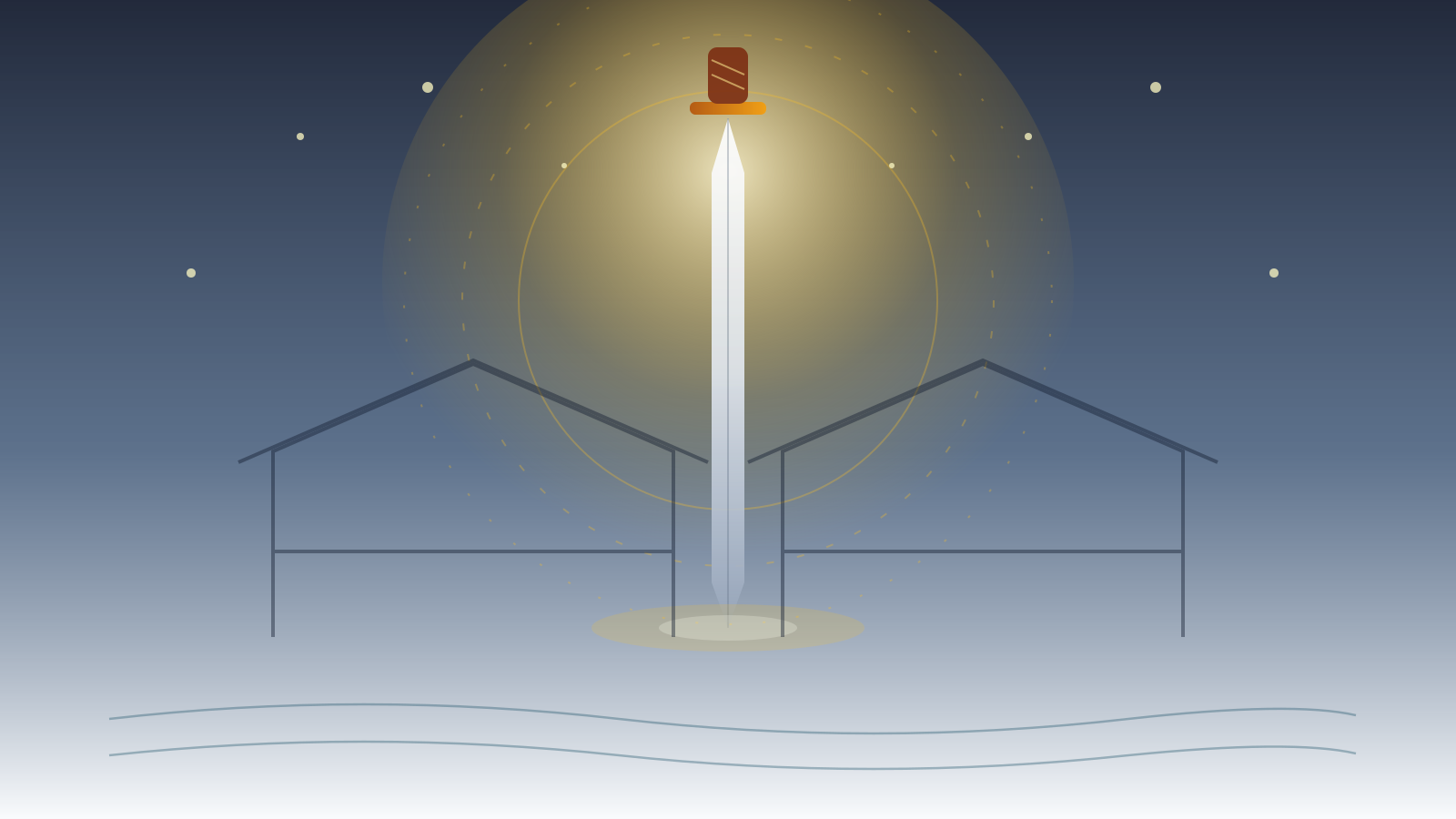
Takakuraji woke and, half-doubting, opened the storehouse door — and there, truly, stood a single sword, driven point-down into the floor as if planted there.
The sword's name was Futsunomitama, the very blade with which Takemikazuchi had secured the ceding of Izumo. When Takakuraji presented it to Emperor Jimmu, the emperor rose as if waking from sleep and said, "How long I have slept." The soldiers felled by the poison then woke one after another and got to their feet.
More remarkable still, the chronicles record that once Emperor Jimmu held this sword, the violent deities of the Kumano mountains were cut down of their own accord. It is not written that he swung it, nor that he fought. Simply because the sword was present, what raged grew still.
The campaign resumed, and guided next by the three-legged crow Yatagarasu, the party reached Yamato at last. Japan's founding story was pulled back from the edge of despair by a dream that one man in Kumano happened to have.
Futsunomitama was later enshrined as the sacred body of Isonokami Shrine in Tenri, Nara, and it remains to this day at the heart of Japan's sacred-sword faith.
Who Was He Really: Identification with Amenokagoyama and the Faith at Yahiko
Takakuraji's true identity has been discussed in many ways since antiquity.
Traditions such as the *Sendai Kuji Hongi* hold that Takakuraji is the same deity as Amenokagoyama no Mikoto — a son of Nigihayahi, the god who descended to earth aboard the heavenly rock-boat before the imperial grandson's descent. If so, Takakuraji carries the blood of a pioneer deity who reached the earth ahead of the main heavenly line.
A man who belongs to the heavenly lineage yet has already put down roots on earth, living in the land of Kumano. Precisely because he stood with one foot in each world, he could receive a heavenly command in the form of a dream. That is one way to read it.
Takakuraji, as Amenokagoyama, was revered as the ancestral deity of powerful ancient clans such as the Owari and the Amabe. He is enshrined today as the principal deity of Yahiko Shrine in Niigata, the first-ranked shrine of Echigo Province. According to shrine tradition, Amenokagoyama came ashore in Echigo and taught the inhabitants how to make salt from seawater and how to fish with nets.
A god who delivers a divine sword becomes, next, a god who teaches salt-making and fishing. A single consistent character shows through here. This deity always plays the role of bringing what is needed to those who do not have it. Whether the cargo is a sword or a technique, only the contents change; what he does remains the same.
The Night Sleep Untangles a Problem: What Takakuraji's Dream Shows
The most memorable feature of Takakuraji's story is that the decisive revelation arrived as a *dream*.
This does not feel like mere mythological decoration — because every one of us has had a similar experience, differing only in scale.
There was a night, some time ago, when I hit a wall at work. Something in the problem simply would not add up, and I paced the same few steps in front of my desk for hours. In the end no answer came, and I remember going to bed in a state close to giving up.
Yet the next morning, the instant I woke, the answer to the knot that had defeated me the night before felt as though it were already in my hands. I had gained no new information. I held exactly the same materials as the night before. And still, I could clearly see which strand of the tangle needed to be pulled.
What I felt then was not that I had become smarter, but the strange sense that something had been sorted out during the night. There was no feeling of having solved it by my own effort; it felt closer to finding it simply left there for me.
I suspect Takakuraji's feelings when he opened the storehouse door that morning were not so different. It was not a sword he had forged. It was not a sword he had gone out to fetch. It was simply there when morning came.
The link between sleep and problem-solving is in fact well supported. During sleep, the brain organizes information gathered during the day and reshapes it into a form suited for long-term storage. In REM sleep in particular, distant memories become more likely to connect with each other, making it easier for ideas to emerge that would not occur to a waking mind. Experiments have found that sleeping on a stalled problem raises the rate at which people solve it the following morning.
In other words, "sleeping on it" is not mere procrastination. It is an active method: taking your conscious hands off the problem so the brain can go on working. Takakuraji's dream may be this human mechanism told in the language of myth.
The Hero Who Never Swung the Sword: The Value of the One Who Delivers
There is another large teaching in this story that is easily overlooked.
This god never once wields Futsunomitama himself.
He receives the dream, takes the sword from the storehouse, carries it to the emperor, and offers it. That is the whole of his action. The sword was forged by smith deities such as Amatsumara; its power was invested by Takemikazuchi; and it was Emperor Jimmu who used it to pacify Yamato. Takakuraji handles a single point in that long chain: the step of *carrying*.
And yet, had that one point been missing, none of the rest would have held together. A divine sword in heaven is of no use whatsoever if it does not reach the people lying stricken in the mountains of Kumano. Power becomes power only once it arrives.
In modern work and life, we often feel that unless we are the protagonist, our contribution is meaningless. We want to be the one who forges the blade or the one who swings it. The role of merely carrying looks plain and replaceable.
But Takakuraji's myth argues otherwise. There are those who have fallen, and there is a power that has not yet reached them. Without someone to bind the two together, the world simply stops there. The person who introduces someone's talent to the place that needs it, who hands buried information to the person it matters to, who carries a silenced voice to where it can be heard — the work of such connectors rarely survives as an achievement under their own name, yet it steers the fate of the whole.
That his name means "keeper of the storehouse" is suggestive too. A storehouse is where things not yet in use are kept. The world is full of powers that already exist and go unused. To open that door and carry them to whoever needs them looks unheroic, and is in fact among the most creative work there is.
Three Practices for Bringing Takakuraji's Teaching Into Modern Life
Here are three practices we can carry from this myth into daily life.
First, when you are stuck, deliberately let a night pass. Grinding away at an unanswerable problem looks conscientious but is often inefficient. Before you stop, make sure the shape of the question is clear. Write down in a single line what it is you actually need to decide, then sleep. In the morning, before you sit down at your desk, spend a few minutes recalling that question without looking at anything. Just as Takakuraji opened the storehouse door first thing in the morning, the moments right after waking are when what was sorted overnight is easiest to retrieve.
Second, build the habit of converting intuitive signals into action. Takakuraji's greatness lies not in having the dream but in going to open the storehouse exactly as the dream said. A thought that flickers up, a vague sense that something is off — leave it alone and it will vanish within hours. Always write down the intuitions that surface, and take one small verifying action on one of them the same day. "Send the message." "Go and look once." That is enough. Dreams hand the sword only to those who go and open the door.
Third, actively take on the role of the one who delivers. Look around you for pairings where the power one person needs is already held by someone else. Person and person, information and person, opportunity and person. That bridging may never be counted as your accomplishment. Yet that single move can dissolve someone's impasse entirely. In every age, there are never enough people willing to open the storehouse and carry.
The Message Takakuraji Conveys to Us Today
What Takakuraji teaches us is this: when you change the world, what you hold in your hand is probably not something you made yourself.
On a night in Kumano, a sword fell from heaven into one man's storehouse. He had not forged it, nor had he asked for it. He simply opened the door as the dream had told him and carried it to the people lying stricken. That alone raised a despairing army to its feet and set the story of Japan's founding moving again.
When we are able to help someone, the structure is usually the same. We do not conjure something out of our own brilliance; we carry what we happened to know, the connection we happened to have, the piece of information that happened to catch our eye, to the person who needs it. Whether or not we begrudge the effort of carrying those "happened to"s changes the outcome enormously.
And one more thing. If you feel that you are the one currently laid low by poisonous air, remember this. What saved Emperor Jimmu was not a surge of his own resolve. For someone who has fallen to rise again, a blade must arrive from outside. Asking for help is not weakness; it is opening the road along which the sword can arrive.
The storehouse door stands quietly closed today as well, waiting to be opened. There may be unused power sleeping inside you. And in someone else's storehouse may lie exactly what you need. Go and open that door first thing in the morning. Across more than a thousand years, the myth of Takakuraji keeps gently urging that one step.
About the Author
Japanese Gods Encyclopedia Editorial TeamWe share the stories and teachings of Japanese gods in a way that is easy to understand and applicable to modern life.
View author profile →Related Articles
Isshomochi: The First-Birthday Rice Cake Rite and a Lifetime of Wishes for a Child
Ukai: The Sacred Cormorant Fishing That Teaches Trust and Coexistence
Hidarugami: The Hunger Spirit of Mountain Passes and the Wisdom of Keeping Something in Reserve
Takaokami: The Dragon God of the Mountain Water Source, and a Way of Living That Circulates Blessings