Ukai: The Sacred Cormorant Fishing That Teaches Trust and Coexistence
Explore the millennium-old history of ukai, cormorant fishing, and its life as a sacred rite. Discover its appearance in the Kojiki, the myth of a birthing hut thatched with cormorant feathers, the sweetfish offered to the gods, and the deep bond between fisher and bird.
What Is Ukai: A Riverside Rite More Than a Thousand Years Old
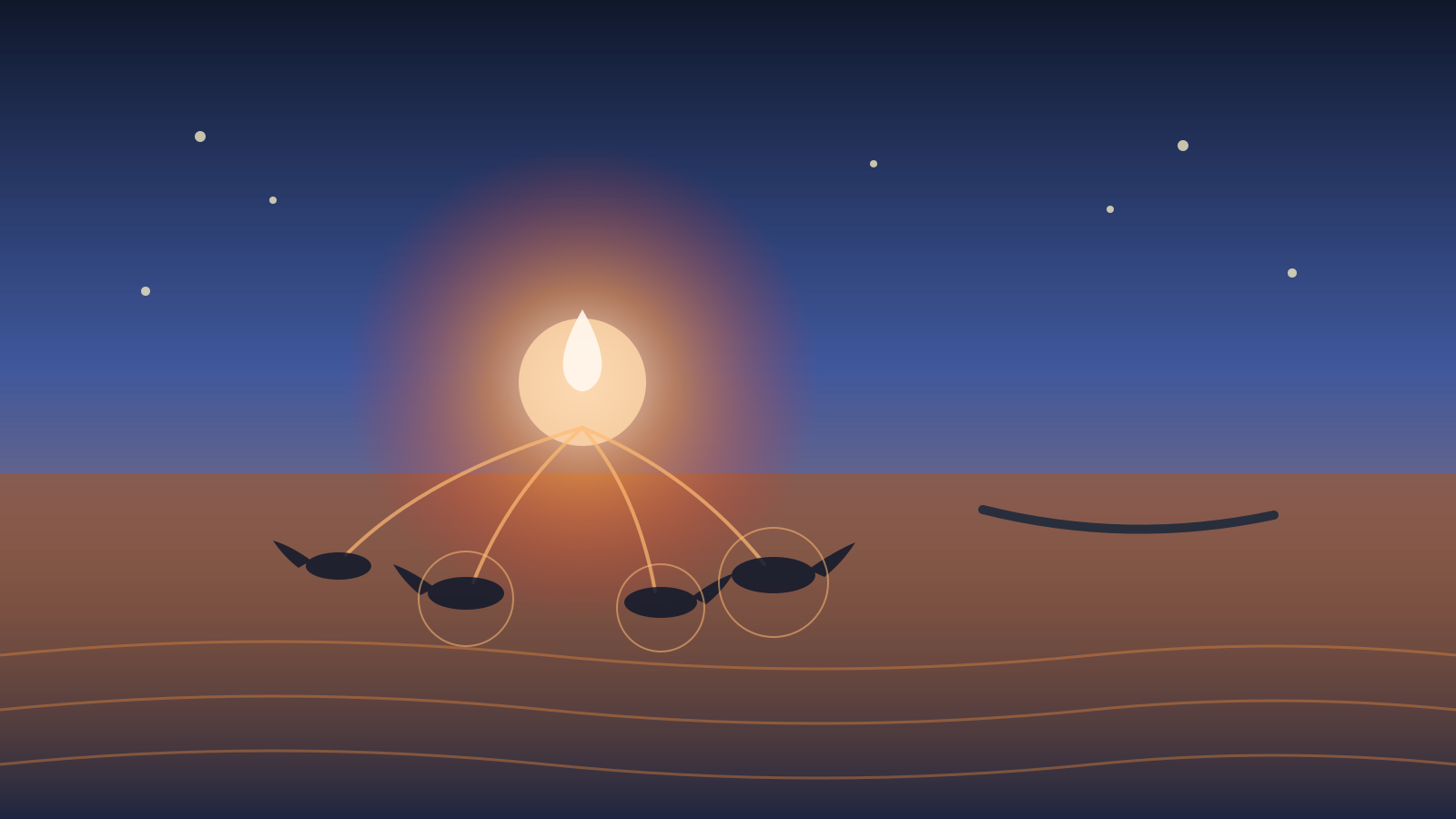
On a summer night, bonfires sway above a pitch-dark river, staining the water vermilion. Standing at the prow of the boat, the usho — the cormorant master — wears a kazaore eboshi cap and a skirt of straw, the ancient costume unchanged, and manages more than a dozen hand-lines gathered in his left hand alone. At the end of those lines are the cormorants, diving into the water.
This is ukai. It is a method of catching river fish, above all the ayu sweetfish, using cormorants, and it has continued in Japan for well over a thousand years. From the Nagara River in Gifu to the Hiji River in Ehime, the Mikuma River in Oita, and the Uji River in Kyoto, it is still carried on in many places as a signature sight of summer.
Yet to view ukai merely as a curious fishing technique or a tourist spectacle is to miss its essence. Since ancient times, ukai has been a sacred labor for catching pure fish to offer to the gods, bound inseparably to prayers of gratitude for the blessings of water. The bonfire is a sacred flame illuminating the dark, and the master's costume still preserves the appearance of one attending a rite. That scene floating on a summer river is, in truth, a thousand years of prayer continuing in changed form.
The Original Scene in the Kojiki, and the Birthing Hut Thatched with Cormorant Feathers
The history of ukai is astonishingly old; it already appears in Japan's earliest surviving book.
In the passage of Emperor Jimmu's eastern campaign in the *Kojiki*, there is an account of the emperor encountering, on the bank of the Yoshino River, a man catching fish with a trap called an *ue*. This figure is described as the ancestor of the cormorant fishers of Ada. In other words, already in the age of the founding myths there existed a clan whose livelihood was fishing with cormorants, and their ancestor was remembered as important enough to appear along the emperor's route.
Descriptions of fishing with cormorants appear as well in the *Nihon Shoki* and in regional gazetteers, and old Chinese histories are said to record, among the customs of the land of Wa, the practice of using birds to catch fish. Ukai was already part of riverside life in the very era when the shape of the Japanese state was forming.
The ukai of the Nagara River is said to have a history of more than thirteen hundred years. It is told that in the Warring States period Oda Nobunaga protected the cormorant fishers and granted them the title of *usho*, and in the Edo period the Tokugawa house protected ukai as well. That the powerful of each era repeatedly sought to preserve this fishery can only mean they recognized in it a sacred value beyond mere fishing.
Why, in the first place, has the cormorant been regarded as so sacred a bird? A clue lies hidden in an important scene of Japanese mythology.
When Toyotamahime, daughter of the sea god, was to give birth to her child by Hoori, a birthing hut was built on the shore. What was chosen to thatch its roof was cormorant feathers. But labor came before the roof could be finished, and the child born there was named Ugayafukiaezu — "the child whose roof of cormorant feathers could not be thatched in time." This deity is the father of Emperor Jimmu, the first emperor.
Why cormorant feathers for a birthing hut's roof? The cormorant dives into water and also soars into the sky. As a being able to pass between the world of water and the world of the heavens, between the sea god's realm and the realm of the heavenly descendants, it was surely seen as a sacred bird that crosses boundaries. At the place where new life is born, in the interval between life and death, sea and land, cormorant feathers were fitting.
Knowing this myth changes how ukai looks. When the master sends his cormorant into the water by way of the line, he is also dispatching a sacred messenger into a world at the riverbed that human hands cannot touch. The cormorant mediates between people and the realm beyond their reach.
Sweetfish Offered to the Gods: The Imperial Ukai and Prayers of Dedication
Nothing shows the sacred character of ukai more clearly than where the caught fish go.
The cormorant masters of the Nagara River still inherit an exceedingly rare status: *usho* of the Board of Ceremonies of the Imperial Household Agency. Households that transmit the art of ukai as a service to the imperial family have guarded that skill for generations. And each year, at a special fishing ground called the *goryoba*, the imperial ukai is held. The sweetfish caught there are presented to the imperial family and, it is told, dedicated to Ise Jingu and Meiji Jingu as well.
In other words, the sweetfish taken in ukai are not merely fish to be sold for profit; they are *shinsen*, food offered to the gods. The ayu is also called the "fragrant fish," a creature that can live only in clear streams and thus a symbol of unpolluted water. A pure fish raised in a pure current, caught on a night lit by pure fire, by pure procedure, and offered to the gods. Every element of ukai connects at this single point of purity.
At ukai sites across Japan, rites are held at the opening of the season to pray to river and water deities for safety and a good catch, and prayers of thanks are offered at its close. Ukai is not a fishery to which rites were later appended; from the beginning it was one with prayer.
The Bond Between Master and Bird: Not a Tool but a Partner
In speaking of ukai, one question cannot be avoided: isn't it cruel to the cormorants? A cord is tied at the bird's throat so that large fish cannot be swallowed. Isn't that simply exploiting an animal?
Yet learning how the masters live reveals an entirely different picture. The cormorant master lives on the same grounds as his birds, observes their condition daily, and reads their state from the gloss of their feathers, their appetite, the brightness of their eyes. The tightness of the throat cord — the *kubiyui* — is adjusted for each individual bird and for each day. Too tight and the bird suffers; too loose and it swallows even the large sweetfish. It is set so that small fish can be eaten by the bird itself, and after the fishing the birds are always fed.
Cormorants, moreover, are long-lived birds. Some spend a decade or more, sometimes far longer, with their master, and the master comes to know each bird's temperament thoroughly. Where each bird is placed on the boat is decided with even the birds' compatibility with one another in mind. Call a bird's name and it responds; from the slightest motion of the hand-line it reads the master's intent. There exists a wordless mutual understanding built up over long years.
The people who have carried ukai on for more than a thousand years did not refine a technique for *using* cormorants. They refined a craft that can exist only by *partnering* with them.
The Night I Couldn't Delegate, and the Cormorant Master's Hand
When I learned of this relationship between master and bird, I remembered a certain evening.
Work I had handed off to someone else was slow in coming back. Waiting, I grew restless, and in the end I took it over and reworked it myself. The task finished quickly. But what lingered afterward was not satisfaction; it was an aftertaste I could not name. I had decided to entrust it, and yet I had not been able to trust all the way to the end.
What surfaced then was the image of a cormorant master sending his bird out into dark water. The master cannot see the riverbed. What the bird is doing down there, whether it will seize a fish, is invisible to him. Even so, relying only on the faint movement at the end of the hand-line, he trusts the bird and waits. He suppresses the urge to grab the line and pull it back, and in the darkness simply waits while the bird dives by its own strength and chases fish by its own judgment.
The line connects, but it does not control. That exquisite sense of distance, I realized, is the very heart of the craft. Trust is neither casting someone loose nor drawing them close to your hand; it is leaving a single thin line in place and waiting while the other person exercises their power somewhere you cannot see. Thinking of it that way, my restlessness that night felt a little embarrassing — and, somehow, a little endearing.
Three Practices for Bringing the Wisdom of Ukai Into Daily Life
Let me name three pieces of wisdom from ukai that we can carry into modern living.
First, trust, at the distance of a single line, those who exercise their power where you cannot see. At work and at home alike, we can never see everything another person does. Try to manage it all and they become unable to move; let go entirely and the relationship snaps. Leave one thin line — that is, maintain only a connection that can respond at any moment, and entrust the rest. Simply being conscious of this distance makes relationships remarkably lighter.
Second, do not take too much. Compared with sweeping a river with nets, ukai is by no means an efficient method. But precisely for that reason it has continued for over a thousand years without exhausting the river. Rather than taking all you can, take only what lets you continue. The same principle applies to how much work you accept and how much you schedule in a day. Endurance lies beyond optimization, not maximization.
Third, always return a portion of the blessing. In ukai, the sweetfish caught are offered to the gods and shared with the birds. Not everything becomes your own share. The habit of returning part of what you gain to the people and places that supported you strengthens, over the long run, the very ground you stand on.
The Message Ukai Conveys to Us Today
What ukai conveys is this truth: beings who differ from one another accomplish a shared work not through domination but through trust.
A human cannot dive underwater; a cormorant cannot kindle fire. Each carrying what it cannot do, they are nonetheless connected aboard one boat by a single line. This relationship holds not because one party is superior, but because what is missing in each meshes with the other. The secret of a craft that lasted a thousand years lay, surely, less in technique than in the quality of this relationship.
Bonfires light the water, cormorants dive, the master grips his lines. That scene is not humanity conquering nature but humanity living arm in arm with it. In an age that rushes toward efficiency and results, ukai shows us a way of living that is both extremely old and extremely new.
If ever you entrust something to another and find yourself anxious, remember the cormorant master gazing at dark water through the night. Because you cannot see, you trust. You hold the line and, without pulling, you wait. Beyond that quiet patience, an unexpected blessing is drawn up from depths you could never have reached alone.
About the Author
Japanese Gods Encyclopedia Editorial TeamWe share the stories and teachings of Japanese gods in a way that is easy to understand and applicable to modern life.
View author profile →Related Articles
Hidarugami: The Hunger Spirit of Mountain Passes and the Wisdom of Keeping Something in Reserve
Takaokami: The Dragon God of the Mountain Water Source, and a Way of Living That Circulates Blessings
Asuha: The God of Home and Ground Beneath Our Feet, and the Wisdom of Firming the Foundation of Family Life
Amenooshihi: The Ancestral God of the Otomo Clan Who Armed Himself to Lead the Heavenly Descent, and the Courage to Take the Vanguard