Kinshi: The Golden Kite That Led Emperor Jimmu to Victory and the Power of Light to Draw In Opportunity
Discover Kinshi, the golden kite that alighted on Emperor Jimmu's bow and routed his enemies with dazzling light. Learn the meaning of this victory myth and how it teaches us to draw in opportunity and break through hardship today.
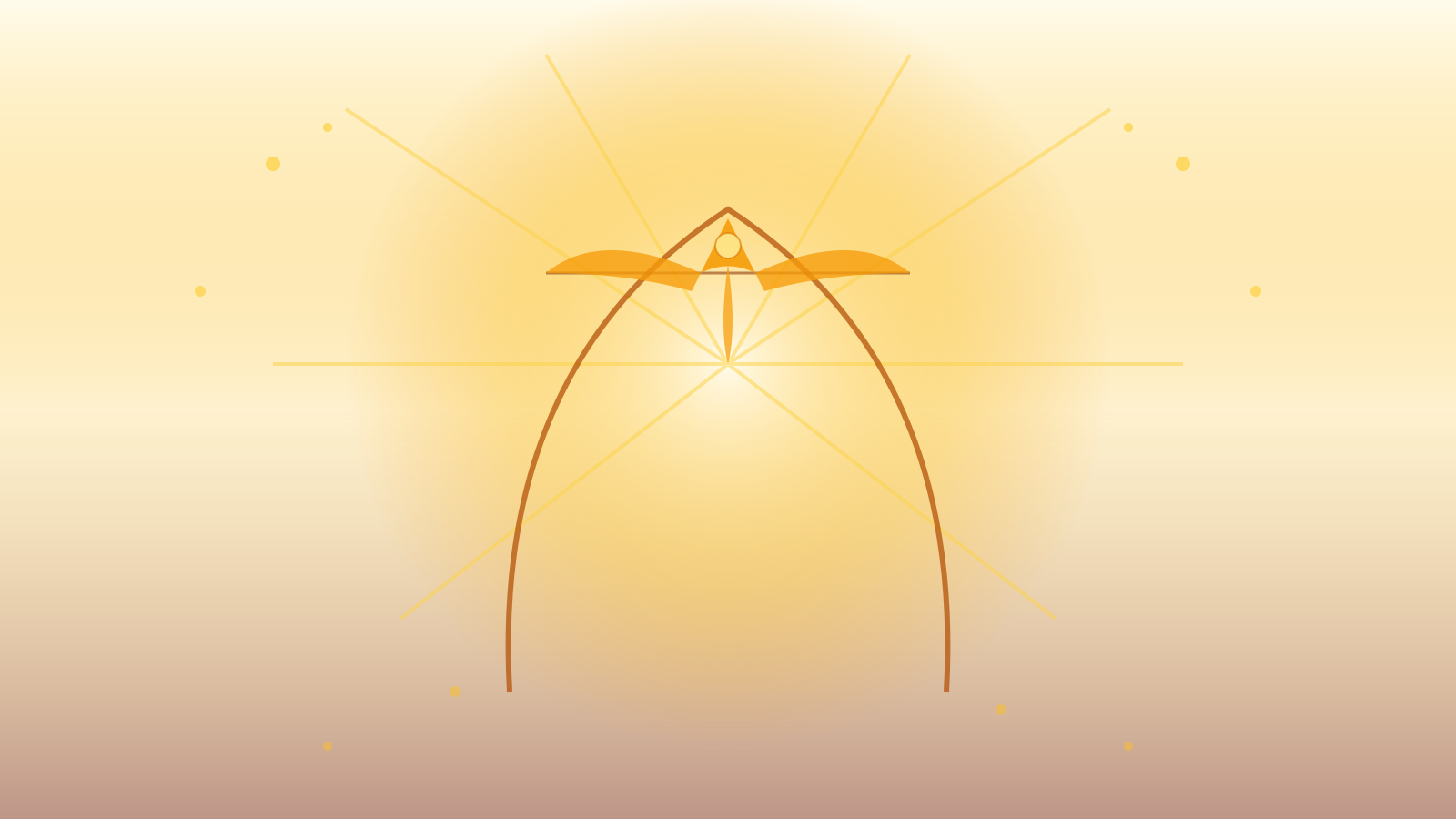
What Is Kinshi: The Golden Kite That Alighted on a Bow
Kinshi, the golden kite, is one of the most vividly radiant figures in all of Japanese myth. It appears in the final phase of the eastern expedition of Emperor Jimmu, Japan's first emperor. A sacred bird, it is said to have alighted on the tip of the emperor's bow and emitted a dazzling golden light that routed the enemy army in an instant. The tobi, or black kite, is a bird of prey in the hawk family, and its figure soaring high and free across the sky has long been revered as a sacred bird linking heaven and earth.
According to the Nihon Shoki, this golden kite appeared at the very moment when Emperor Jimmu was struggling in a fierce battle against Nagasunehiko, who ruled the land of Yamato. A kite shining with golden light suddenly flew in, and when it perched on the yuhazu, the tip of the bow the emperor held, the light radiating from its body shone like lightning and blinded the enemy soldiers. This single instant decided the course of the war, and Jimmu defeated his old foe and at last ascended as the first emperor at the land of Kashihara.
Kinshi is no mere bird. It is the symbol of the moment the will of heaven descended to earth, a sacred being that brought "opportunity" and "the light of victory" to a hero in distress.
The Hardships of Jimmu's Expedition and the Coming of Kinshi
To understand the meaning of Kinshi deeply, we must know the context of the grand story of Jimmu's eastern expedition. Emperor Jimmu — known in childhood as Sano-no-Mikoto and later as Kamuyamato-Iwarebiko-no-Mikoto — set out eastward from Hyuga, present-day Miyazaki, aiming for Yamato to build an ideal land. Yet his journey was anything but smooth.
He met resistance in region after region, and his elder brother Itsuse-no-Mikoto died of a battle wound. The party lost their way in the mountains of Kumano, were felled by the poisonous breath of a great bear, and fell into a desperate plight. There a sacred sword was sent down from Takamagahara, and by the guidance of Yatagarasu, the three-legged crow, they barely found a way through. And the last barrier at the end of the long, arduous campaign was the powerful Nagasunehiko.
Defeated again and again, on the very verge of giving out, that was when Kinshi appeared. In other words, Kinshi was the symbol of the "decisive opportunity" that comes only before those who have given their all and endured every hardship. It does not appear before those who simply wait doing nothing. The light alighted on the bow of the one who had kept walking and fought to the end.
The Meaning of Light Routing the Enemy: A Breakthrough That Lights the Dark
There is deep symbolism in the account that the golden light Kinshi emitted blinded the enemy soldiers and brought victory. Since ancient times, light has symbolized wisdom, truth, and hope, while darkness has stood for confusion, hardship, and despair. The image of "light" finally shining before Emperor Jimmu after he had come through the darkness of a long and bitter expedition tells precisely the universal truth that "the light of a breakthrough shines at the very depth of hardship."
What deserves attention is that Kinshi changed the battle not with a sword or martial force but with "light." Rather than crushing by force, a dazzling light blinded the enemy for an instant and shifted the tide. This hints that a true breakthrough is often brought not by overwhelming power but by a single flash of insight, a moment when one's field of vision opens up. What breaks a deadlocked situation is not a forceful push but a fresh perspective that suddenly shines in.
In the Meiji era, the Order of the Golden Kite was established in honor of Kinshi to commend military merit, and Kinshi became widely known to the people as a symbol of victory and glory. The light emitted by a single bird remained carved in people's memory across more than a thousand years.
The Light of Kinshi I Recalled on a Night I Was Stuck
After I learned the myth of Kinshi, there came a moment that overlapped with a small experience of my own. On one piece of work, I faced the same problem for days, could find no exit no matter how I thought about it, and clung to my desk late into the night. The more I thought, the narrower my view became, as if I had lost my way in a deep forest like Jimmu's party.
Worn out, I once closed everything and gazed absently out the window. The lights of the town caught my eye, and in a corner of my mind an idea from a completely different angle quietly surfaced. It was not an especially clever thought, but it was the distinct sensation of a single ray of light shining into a situation that had been stuck fast. When I tried that idea the next morning, the problem that had refused to budge moved forward with surprising ease.
In that moment I thought, "Ah, perhaps this is the light of Kinshi." Light shines not on the one who stops thinking and waits, but in the instant one relaxes after thinking to the very limit and struggling on. That Kinshi perched on Jimmu's bow was, too, a single instant at the end of his fighting on — that understanding settled into me anew.
What People Who Draw In Opportunity Have in Common: A Reading from Modern Science
If Kinshi symbolizes "opportunity that comes at the end of effort," its teaching resonates with modern science as well. According to research by the psychologist Richard Wiseman, the difference between people who feel "I am lucky" and those who feel "I am unlucky" lies not in inborn fortune but in their attitude toward noticing opportunity and seizing it. People who feel lucky keep a wide field of view and stay open to chance encounters and stray pieces of information.
This matches what the myth of Kinshi conveys. Emperor Jimmu was able to make use of Kinshi's light as an "opportunity" because he had kept walking without giving up until then. Only the one who has made preparations and continued to act can grasp an opportunity when it finally arrives. Chance shows itself only before the person who stands ready to receive it.
Insights from neuroscience also show that when a person keeps concentrating on a single problem, thinking tends to become fixed, and that stepping away once, inserting rest or a different activity, makes wholly new ideas more likely to arise — the incubation effect. To change one's viewpoint precisely when stuck — this too can be called a modern practice for calling in the light of Kinshi.
Three Practices for Bringing the Light of Kinshi Into Daily Life
To put the teaching of Kinshi to use in modern living, I suggest three practices.
First, keep walking until opportunity arrives. Kinshi did not appear before those who did nothing. Even when results are not immediately visible, calmly continue what you can do. That accumulation becomes the bow that receives the light when it one day shines in. Regard today's small step as preparation for tomorrow's opportunity.
Second, when you are stuck, widen your view once. Rather than brooding in the same spot, go for a walk, do a different task, talk with someone — actions that switch your perspective call in unexpected breakthroughs. Just as Kinshi's light changed the battle in an instant, a fresh viewpoint often unravels a deadlock all at once.
Third, do not overlook the light that shines in; seize it at once. An idea that suddenly surfaces, a chance encounter, an unexpected invitation — do not let these pass as "mere coincidence," but move them into action as opportunities. Just as Emperor Jimmu did not miss Kinshi's single instant, the swiftness to grasp the light that arrives is what divides destinies.
The Message Kinshi Conveys to Us Today
What the myth of Kinshi teaches us is the hope that "light alights on the bow of the one who did not give up to the end." Life will always have hardships that stand in the way, like Nagasunehiko. There will be nights when you are defeated again and again, can find no exit, and feel on the point of giving out. Yet the myth tells us that it is precisely at such an extreme that the golden light shines in.
What matters is not simply to wait for the light to come, but to keep drawing a bow worthy of the light alighting on it. Do not stop walking, open your field of view, hold the readiness to seize opportunity — that very attitude calls forth your own Kinshi.
The deeper the hardship you face today, the more brightly the light beyond it will surely shine. With the story of Kinshi in your heart, try taking just one more step forward. For a day will surely come when golden light alights on the tip of your bow.
About the Author
Japanese Gods Encyclopedia Editorial TeamWe share the stories and teachings of Japanese gods in a way that is easy to understand and applicable to modern life.
View author profile →Related Articles
Tokoyo: The Eternal Land Beyond the Sea and the Japanese Vision of Life, Death, and Hope
Teru-teru-bozu and the Gods of Fair Weather: Japan's Folk Faith of Praying for Sunshine
Takasago and the Aioi Pine: The Wisdom of Lifelong Marriage from the Elder Couple Jo and Uba
Doyou and Mabi: Japan's Seasonal Threshold Faith for Health and Fortune at the Turn of the Year