Yashikigami: The Household Guardian Spirits That Protect Japanese Homes
Discover the ancient tradition of Yashikigami, guardian spirits enshrined within Japanese homes, and learn how this folk belief teaches gratitude and protection in daily life.
Origins and Historical Background of Yashikigami
The worship of household guardian spirits belongs to the oldest stratum of Japanese folk religion. Its origins are believed to trace back to the late Jomon period and the transition to the Yayoi era, when people first began settling permanently on the land. As communities established fixed dwellings, built homes, and cultivated fields, they came to believe that spiritual power resided within the land itself. This conviction formed the prototype of Yashikigami worship.
Historical references appear as early as the Heian period, with the Engishiki containing descriptions of rituals dedicated to protecting residential compounds. During the medieval period, the practice of enshrining household guardian spirits spread widely among warrior households, and during the Sengoku era, protective deities were installed even within castle fortifications. In the Edo period, the custom permeated commoner society, with merchant families increasingly inviting Inari deities to serve as their household guardians in hopes of business prosperity. Even through the modernization that followed the Meiji Restoration, these traditions were faithfully preserved, particularly among established families in rural areas.
Classification and Regional Variations of Yashikigami
According to the folklore studies of Kunio Yanagita, Yashikigami can be broadly classified into three lineages. The first is the ancestral spirit type, which venerates the founding ancestors and protective spirits of the family line. This form is prevalent in the Tohoku and Hokuriku regions, where the first settlers of a household are revered as Ie no Kami, or gods of the house. The second is the land spirit type, which honors the indigenous spirits and earth deities that originally inhabited the land. Known as Jinushi-sama or Chigami-sama across the Kanto and Chubu regions, this type reflects an ancient respect for the genius loci. The third is the Inari type, in which deities of abundance such as Inari or snake gods are formally invited to protect the property. This was especially common among merchant houses in Kyoto and Osaka, where families would receive branch spirits from the great Fushimi Inari Shrine.
Regional names and customs are remarkably diverse. In Okinawa, the Hinukan, or fire deity, serves as the household guardian and is enshrined in the kitchen. In Kyushu, the deity is called Uchigami-sama and is closely associated with agricultural prosperity. The Oshira-sama tradition of northeastern Japan can also be considered a form of Yashikigami, with sacred figures carved from mulberry wood serving as protectors of silkworm cultivation. Across Japan, the Yashikigami takes on different forms that mirror the geography, industry, and cultural heritage of each region.
Methods and Rituals of Enshrining Yashikigami
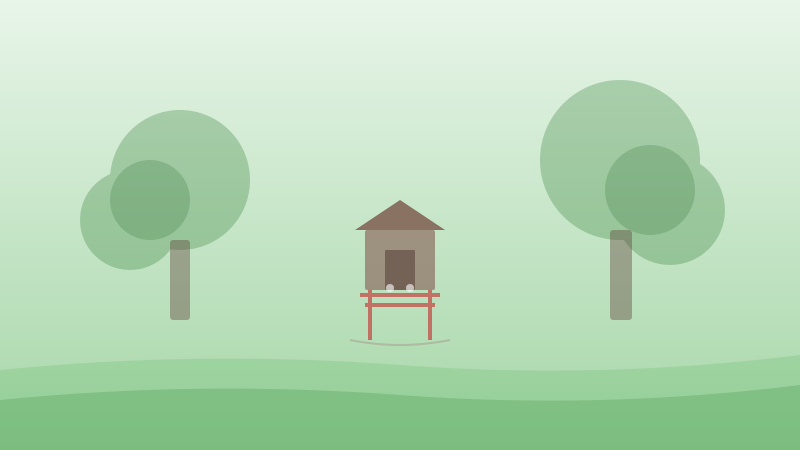
The location for enshrining a Yashikigami is typically chosen in the northwest corner of the property, known as the rear demon gate in feng shui tradition, the northeast direction, or a quiet secluded spot within the grounds. This placement is rooted in geomantic thinking, with the intention of positioning protective power at points where malevolent energy is believed to enter most easily. The size of the hokora, or miniature shrine, varies with the family's status, but most are modest wooden or stone structures standing between thirty centimeters and one meter in height.
Inside the hokora, the sacred object may take the form of a talisman, a stone, a gohei paper offering, or even a shed snake skin. Snakes have been regarded as land guardians since ancient times, and the custom of offering found snake skins to the Yashikigami persists in many regions. Standard offerings include rice, salt, water, and sake, which are replaced with fresh portions on the first and fifteenth of each month. During special occasions such as New Year, the spring and autumn equinoxes, and the Obon festival, families prepare elaborate offerings of sekihan red rice, mochi, and seasonal fruits, and the entire household gathers to pay their respects.
An important principle is that the area surrounding the hokora must always be kept clean. Weeds are trimmed, fallen leaves swept away, and any damage to the shrine is promptly repaired. This is not mere housekeeping but an expression of reverence toward the divine, embodying the Japanese spiritual principle that cleaning is the beginning of prayer.
The Deep Connection Between Yashikigami and Household Fortune
Perhaps the most fascinating aspect of Yashikigami belief is the concept that the deity and the household share an interdependent fate. When the family prospers, the guardian spirit grows stronger and provides even greater protection. Conversely, when the family declines, the Yashikigami weakens and may eventually depart. This relationship of mutual dependence reflects the Shinto philosophical principle that gods and humans grow together.
Folklore surveys have documented numerous traditions across Japan in which families who neglected their Yashikigami subsequently experienced misfortune. In one well-known account from Niigata Prefecture, the head of an old family fell seriously ill immediately after relocating the household shrine, only to recover once the hokora was returned to its original position. While science cannot establish a causal relationship, these stories serve as powerful reminders about the consequences of neglecting respect for the unseen.
The handling of a Yashikigami during a household relocation was a matter of great importance. When moving to a new property, the family would first report their intentions to the existing deity and conduct a formal transfer ceremony known as senza no gi. If the hokora had to be left behind, arrangements were made for the spirit to be enshrined at a nearby Shinto shrine, ensuring it was never simply abandoned. This custom survives in modified form today in the purification ceremonies and ground-breaking rituals performed before demolishing old buildings or beginning new construction.
Yashikigami Faith in the Modern World
Urbanization and the rise of the nuclear family have significantly transformed the traditional practice of Yashikigami worship. Yet the tradition has not vanished entirely. In rural areas, established families continue to maintain their ancestral shrines, while in cities, a growing number of people set up small kamidana household altars on apartment balconies or in living rooms. This evolution demonstrates that while the outward form may change, the fundamental human desire to maintain a sacred space within the home endures.
There are several ways to incorporate this ancient wisdom into contemporary life. The first is to create a small altar or salt offering in the entryway or a corner of the living room. Simply taking a moment each morning to place your hands together and pray for your family's safety can cultivate inner calm. Research in environmental psychology has shown that designating a meaningful space within the home contributes to reduced stress and enhanced feelings of well-being. The second approach is to conduct thorough cleaning at seasonal transitions while consciously expressing gratitude for your dwelling. During year-end cleaning or seasonal wardrobe changes, simply being mindful of the thought that this home protects and shelters us can transform how you perceive your daily surroundings.
Lessons from Yashikigami and Preserving Wisdom for the Future
The most essential teachings that Yashikigami faith conveys to us today can be distilled into three pillars. The first is gratitude toward the place where you live. Our homes are not mere buildings but rest upon the accumulated efforts of countless generations. The land holds memory and history. Becoming conscious of the fact that we live upon that history, and giving that awareness tangible expression, was the very heart of Yashikigami worship.
The second pillar is the awareness of protecting family bonds. As a guardian of the entire household, the Yashikigami brought the family together in shared prayer, fostering unity and connection. In an era when family members tend to spend much of their time separately, the act of gathering before the household deity provides a precious opportunity for family members to face each other and look in the same direction.
The third pillar is reverence for the unseen. It is the capacity to sense something that pure rationality cannot explain, and to treat it with respect. Creating a small sacred space within your daily environment and maintaining moments of prayer brings both comfort and order to everyday life. The ancient tradition of Yashikigami quietly continues to teach us, in a modern society obsessed with convenience and efficiency, the profound importance of connecting with the ground beneath our feet and cherishing the simple act of living.
About the Author
Japanese Gods Encyclopedia Editorial TeamWe share the stories and teachings of Japanese gods in a way that is easy to understand and applicable to modern life.
View author profile →