Itsukushima Shrine: The Floating Sanctuary That Teaches Harmony with Nature's Tides
Discover the history of Itsukushima Shrine's floating sanctuary and its great torii gate, and learn the wisdom of living in harmony with nature's tides.
Origins of the Floating Shrine and Kiyomori's Prayer
The founding of Itsukushima Shrine dates back to 593 CE, when Saeki no Kuramoto is said to have built the first sanctuary after receiving a divine revelation from Ichikishimahime-no-mikoto, one of the three Munakata goddesses. As a guardian deity of safe navigation and maritime travel, Ichikishimahime had long been revered by those who traversed the Seto Inland Sea. Yet the magnificent floating shrine we see today owes its form to a massive construction project undertaken in 1168 by Taira no Kiyomori, the most powerful figure of the late Heian period.
Kiyomori had amassed enormous wealth through trade with Song Dynasty China, but behind his success lay deep devotion to the deity of Itsukushima. He prayed fervently for safe passage along the Inland Sea trade routes and poured his fortune into building a shrine complex modeled on the shinden-zukuri residential style of Heian aristocrats — except built entirely over the sea. The main hall, offering hall, and worship hall stand at the center, with east and west corridors extending approximately 275 meters over the water, representing the pinnacle of architectural achievement of that era.
The bold concept of constructing a shrine over the sea arose from the belief that Miyajima Island itself was a sacred body. Because the entire island was considered divine, stepping directly on its ground was thought to bring defilement. Building the shrine over the water was an ingenious solution to this spiritual concern. This philosophy persists even today — historically, burials and births were avoided on the island to preserve its purity.
Two Faces of the Shrine: The Drama of the Tides
What astonishes visitors most about Itsukushima Shrine is how dramatically its appearance transforms with the tides. The tidal range in the Seto Inland Sea can reach approximately four meters, and this natural force gives the shrine two entirely different faces.
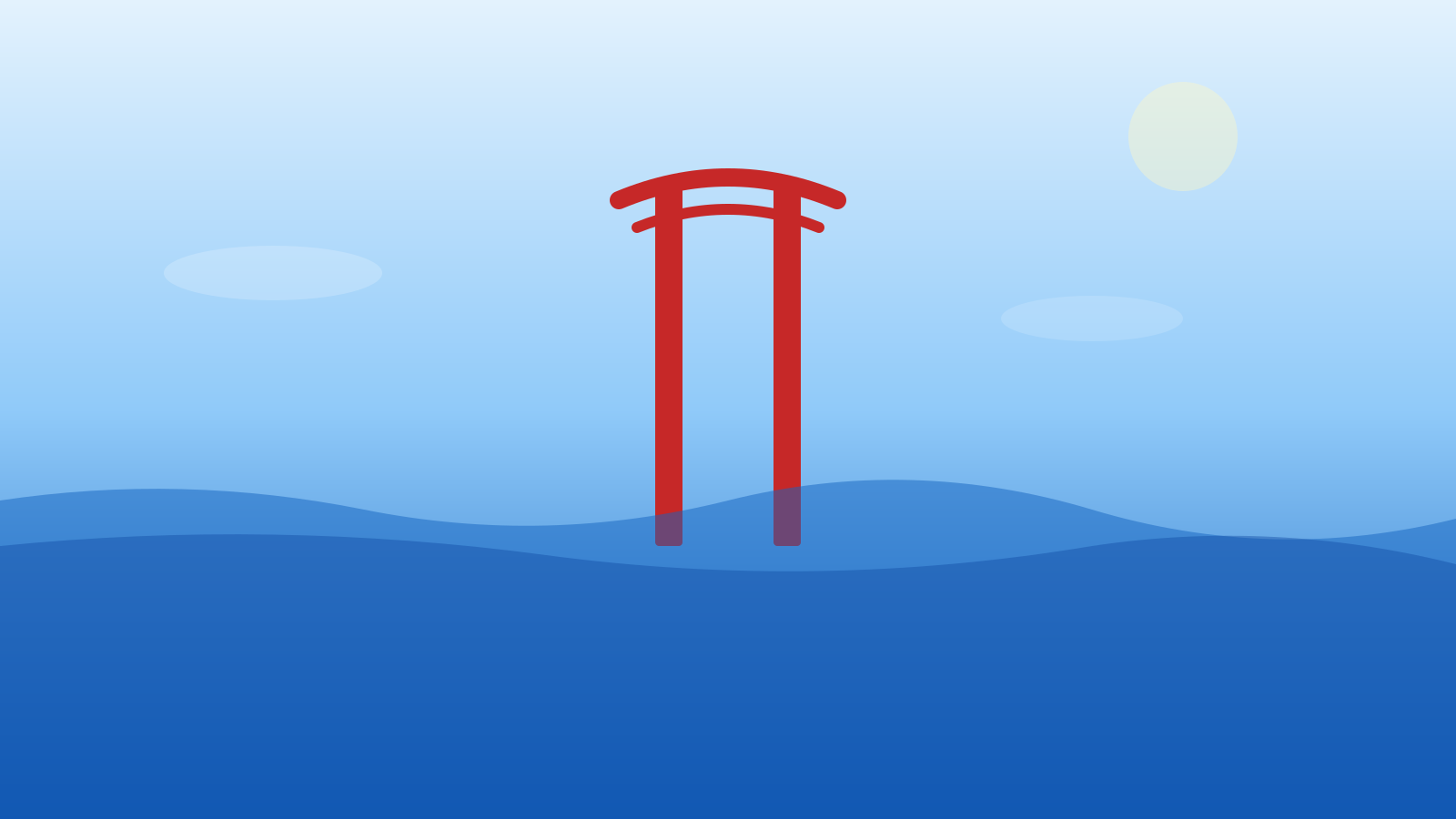
At high tide, seawater fills the space beneath the shrine buildings, and the corridors and halls appear to float like a mythical dragon palace upon the sea. The vermilion pillars reflect on the water's surface, creating an ethereal scene that has captivated photographers and travelers worldwide as the "floating sanctuary." The great torii gate, standing approximately 16.6 meters tall and weighing roughly 60 tons, rises majestically from the water as a symbol of devotion to the sea deity. Remarkably, the torii stands by its own weight alone without being buried in the ground — approximately seven tons of cobblestones packed into the roof structure lower its center of gravity and ensure stability, a testament to the sophistication of ancient engineering.
At low tide, the sea recedes to reveal a vast expanse of sandy beach, allowing visitors to walk right up to the base of the torii gate and touch its massive pillars. This intimate, tactile experience offers a completely different kind of awe from the distant, ethereal view at high tide. Coins wedged into the crevices at the base of the torii by countless pilgrims bear witness to the depth of people's prayers across generations.
The tidal cycle is a natural phenomenon driven by the gravitational forces of the moon and sun. This rhythm, repeating roughly every six hours, represents a cosmic law beyond human control. Rather than treating this uncontrollable natural force as an adversary, the builders of Itsukushima Shrine embraced it as a defining feature of the shrine's beauty and spiritual power.
Engineering Wisdom: Building to Coexist with the Sea
The fact that Itsukushima Shrine has stood over the sea for approximately 850 years is proof of ancient Japanese builders' profound understanding of nature and their exceptional engineering skill. A structure built over water faces constant threats from waves, tidal currents, and typhoons, yet Itsukushima Shrine incorporates ingenious solutions throughout its design.
The floorboards of the shrine buildings are intentionally spaced with gaps between them. This design allows water pressure from storm surges to escape upward through the floor rather than pushing against the entire structure. If the floors were sealed, hydraulic pressure could lift and destroy the buildings. By letting water pass through, the structure "deflects" rather than "resists" nature's force.
The corridor pillars are also notable: they are not fixed to the ground but simply placed upon it. This allows them to absorb the shock of earthquakes and waves flexibly — a concept remarkably similar to modern seismic isolation technology. Because each pillar can move independently, the structure avoids catastrophic failure where the entire framework collapses as a single rigid unit.
The natural cove where the shrine stands also serves as a natural breakwater. The topography created by Mount Misen behind the shrine acts as a natural windbreak and wave barrier, shielding the buildings from direct exposure to heavy ocean swells. Ancient builders are believed to have carefully assessed these geographical conditions when selecting the site for construction, demonstrating a sophisticated understanding of coastal dynamics that modern engineers would recognize and respect.
The Munakata Goddesses and the Faith of Seafaring People
The three Munakata goddesses enshrined at Itsukushima — Ichikishimahime, Tagorihime, and Tagitsuhime — were born from the oath ritual between Amaterasu and Susanoo in Japanese mythology. With their home base at Munakata Grand Shrine on the islands of Okinoshima, Oshima, and Tashima in the Genkai Sea, these deities have been worshipped as guardians of maritime travel since antiquity.
Devotion to the Munakata goddesses was a lifeline for seafaring communities engaged in continental trade. The Seto Inland Sea served as ancient Japan's primary transportation corridor, and for those who carried goods by ship, the protection of sea deities was paramount. Itsukushima Shrine's location at a strategic point along the Inland Sea was no coincidence — it was deliberately chosen as a base for prayers for maritime safety.
Kiyomori's particular devotion to Itsukushima Shrine was rooted in this maritime faith. The Taira clan expanded their power by commanding the sea lanes of the Inland Sea. In the Song Dynasty trade, large vessels navigated from Hakata through the Inland Sea to Owada Harbor (present-day Kobe Port), and Itsukushima, positioned along this vital route, was the ideal guardian deity for the journey. Kiyomori succeeded in trade under the goddess's protection and built the magnificent shrine as an expression of gratitude.
Even in modern times, devotion to the Munakata goddesses remains strong among fishing communities and maritime workers. Many oyster farmers in Hiroshima Prefecture continue the tradition of praying at Itsukushima Shrine for abundant harvests and safety at the beginning of each cultivation season.
World Heritage Status and Modern Conservation
In 1996, Itsukushima Shrine was inscribed as a UNESCO World Cultural Heritage Site. The designation recognized the shrine complex built over the sea as a masterpiece of Japanese religious architecture, and acknowledged that the cultural landscape integrating natural scenery with architecture possesses outstanding universal value. The entire environment, including the primeval forest of Mount Misen, was recognized as a rare cultural heritage embodying the harmony between humanity and nature.
However, World Heritage status also brought the significant challenge of conservation. The shrine buildings, standing in seawater, face constant threats from salt damage, weathering, and biological attachment, requiring regular restoration. Major renovations are carried out on roughly 20-year cycles, and between 2019 and 2022, the great torii gate underwent extensive preservation work. This project included repairing cracks in the gate's base, applying rot-prevention treatments, and repainting the vermilion lacquer.
The primary wood used in restorations is carefully selected camphor (kusunoki), with the main pillars of the torii requiring trees several hundred years old. In recent years, however, sourcing large-diameter camphor trees has become increasingly difficult, prompting reforestation initiatives to ensure supplies for future repairs. The ongoing effort to maintain traditional construction methods using natural materials while passing cultural heritage to future generations represents a delicate balance between preservation and sustainability.
Tourism management is equally critical, with approximately three million visitors annually. In 2023, Miyajima introduced a visitor tax of 100 yen per person, with revenues directed toward cultural property conservation and landscape maintenance. Systems to balance tourism and preservation while transmitting the shrine's value to future generations continue to evolve.
Applying the Tidal Wisdom to Daily Life
The rising and falling tides of Itsukushima Shrine teach us the importance of accepting nature's cycles. The tide always rises, and it always falls. This ceaseless rhythm contains a universal truth that resonates with our own lives.
In work and relationships, there are periods of momentum and periods of stagnation. During high-tide moments when things flow smoothly, we can ride the current and express our full potential. During low-tide periods of stagnation, rather than anxiously trying to force the current to change, we can view it as a time to examine our foundations and gather strength for the next rising tide.
This perspective aligns with contemporary stress research. Psychology has established that resisting things beyond our control amplifies stress. Like the architectural philosophy of Itsukushima Shrine — deflecting natural forces while focusing on what can be done — the attitude of accepting what cannot be changed while concentrating on what lies within our power is scientifically supported as an effective method for building resilience.
When visiting Itsukushima Shrine, try to experience both the high and low tide hours. The shrine's ability to present completely different expressions in the same location speaks more eloquently than words about the beauty of embracing change without fear. Itsukushima Shrine, where prayers flow in rhythm with the breathing tides, is a living sanctuary that distills the Japanese wisdom of coexisting with nature into architectural form.
About the Author
Japanese Gods Encyclopedia Editorial TeamWe share the stories and teachings of Japanese gods in a way that is easy to understand and applicable to modern life.
View author profile →Related Articles
Onbashira Festival: The Sacred Log Riding That Teaches Community Bonds and Renewal
Nurikabe: The Invisible Wall Yokai and What It Teaches About Patience and Changing Perspective
Taizan Fukun: The Deity Who Governs Lifespan and the Value of Every Day
The Carpenter God: Divine Patrons of Japanese Architecture and the Power of Sacred Building Rituals